Living Authentically & Having the Courage to Be Seen

What it means to live authentically
I am deeply inspired by people who allow themselves to be seen.
Those who have the courage to live from the deep, radiant truth in their bones rather than the untethered performance of what they feel is expected of them. Those who take pride in expressing their creativity, two hands gripping tightly around what makes them so interconnected with the soul of the world, without the instinctive reflex to hold back.
Humans like this remind me what authenticity actually requires.
So here I go…
I am a woman who feels deeply. It’s not just something I do, it’s how I move through the world. Emotion shapes and informs how I listen, how I learn, how I love, and how I act. It is both my greatest strength and my most tender, honest teacher.
The depth of feeling that I move with as I create my life keeps me anchored to my truth. Whether it’s convenient or not, I am incapable of pretending. It’s written all over my face and present throughout my entire body.
To feel everything is not graceful. It’s raw and beautiful and messy and ripe with a confusion that only time unravels… then flushed with an overwhelming and widespread clarity that sings broadly through my whole being. Emotions can be illuminating and enlivening while also being heavy, consuming, and disorienting.
If you’re an empath, you know this, too.
Emotional authenticity and the cost of hiding
For a long time, I asked myself:
How can I have the courage to be more myself?
Where am I still holding myself back?
What I have come to understand now is a different question altogether:
Do I have the stamina to keep hiding?
Where am I hemorrhaging energy towards denying myself, and focusing instead on what I don’t want at all?
Because hiding is not passive. It takes enormous energy to suppress your truth, edit your natural instinct, and to leave your body in the name of belonging.
Many of us learned this early; that safety required making yourself as small as possible. This was probably also coupled with the reality that love was both conditional and transactional, and that belonging had to be earned through performance.
The loss of belonging
I know depression intimately. I have worn grief like a blanket of comfort since the age of three. A grief deepened by the loss of my maternal grandmother, paternal grandparents, and then my father, all before I was 21. Losses that fractured my sense of ground and asked me to rebuild myself from the root up.
This grief lives in my lineage and is shaped by centuries of silencing, survival, and displacement. There were seasons when I disappeared into the dark; not as an escape, but as a form of learning. I was coming to understand the cost of disconnection and getting to know the ache of not belonging in the world or in myself, or within my body’s memory. I was also learning that the deep exhaustion I was feeling had, in part, come from abandoning my body in order to endure.
More recently, I have been grieving both my personal and our collective root trauma; an inheritance many of us carry as colonized humans living on what is not our familial land.
I feel the grief of territories taken from my Native American ancestors, alongside the grief of unchecked power structures that claimed what was never offered, never asked for, and never rightfully theirs. A group that decided it was within their rights to take against someone else’s will.
The body remembers everything. So does the land.
As a result, what lingers beneath the surface of both our awareness and our skin is this quiet, unnamed sense of dis-belonging. A deep, unstirred presence of dis-ease living on lands with no ancestral relationship. Living where we have no connection to the nourishment of history, the stories of beloved relatives, or the quiet presence of belonging to something. Instead, settling where we can afford, where we are told we should be, rather than where we feel rooted.
This fracture reverberates through the body, through our sense of safety, trust, and belonging in profound and untold ways. And it’s collectively rising to the surface.
I know this is not everyone’s story.
I name it here as a personal process unfolding within me that I am sharing in service of truth and transparency. And to acknowledge, also, that healing begins at the root.

Performative self-abandonment
This is where much of my work now lives — in what wise therapists call “performative self-abandonment.” These are the subtle, often invisible ways we betray our own needs, instincts, and rhythms in order to feel safe, wanted, or acceptable. It is the quiet, internal negotiation with self that sounds like: Who do I need to be in this moment to feel loved/loveable?
Over time, these micro-adjustments become embodied, automatically activated by our subconscious as needed. These patterns live in our posture, our breath, our tone of voice, and the way we vigilantly track — or stop tracking — sensation. We learn when to soften, when to contract, and when to disappear. What begins as survival becomes habit.
This wound lives in our roots: body, mind, and heart. It’s woven into our relationship with safety, trust, and expression; our sense of permission or right to take up space, to have needs, to move at our own pace; and to tell the truth of what we feel.
When the root is compromised, authenticity feels dangerous.
The body learns that truth is a threat. Expression becomes conditional. We may speak from the mind while leaving the body behind, or offer care outwardly while neglecting our own internal signals. We say ‘yes’ when we mean ‘no’ because it’s safer.
Emotional intelligence, in this context, is a practice of staying — staying with ourselves, staying with sensation and emotion as it moves, staying present long enough to listen rather than override. You don't need to master your feelings. You just pause long enough to act from the present moment instead of the reflex. You take time to respond, instead of reacting from urgency. You stay present, even when the body and mind are screaming to go on autopilot and keep earning love.
Embodiment is the act of returning again and again to what is here, even when it is uncomfortable, unfamiliar, or slow.
To remain with what we feel is an act of repair. Each time we choose presence over performance, we restore trust within ourselves at the root level. The body learns that it is safe to be honest.
Embodiment, emotional intelligence, and staying with what we feel
Emotional intelligence, to me, is a quiet fortitude of understanding. It is not performative, reactive, or loud. That's why no one wins awards for it.
It's steady. It’s a kind of self-discipline, really; staying present with yourself or others long enough to really witness what’s being shared or felt, without interrupting, dismissing, or rushing toward resolution.
At its core, emotional intelligence is a practice of deep listening.
Not listening to alter what is being expressed, but listening to understand. To receive what is here with openness and curiosity. This kind of listening requires restraint. It asks us to slow down and soften our need to do something with what we feel.
And it’s embodiment that makes this possible.
To be embodied is to remain in relationship with sensation as it moves through the body — to notice tightening and softening, heat and heaviness, expansion and contraction — without abandoning ourselves in the process. When we stay connected to the body, emotion becomes information rather than something to fear, escape, or control.
Staying with what we feel is a loving discipline. It is also extremely uncomfortable, unfamiliar, and destabilizing, especially when exploring something new.
Many of us were taught that strong emotions were dangerous or disruptive; a threat to the status quo and, let’s face it, the emotional comfort of others.
“Your discomfort is really bothering me. Can you finish up with that?”
As a result, we learned to override our emotions in order to stay connected or safe. Thinking instead of feeling. Logic over sensation. Certainty above all.
Emotional intelligence asks for something different: presence instead of avoidance, curiosity instead of judgment. When we remain present long enough to witness an emotion — without rushing, analyzing, or dismissing — it begins to reveal its wisdom. The feelings move. The intensity shifts. There’s a release, and that relief informs us. The body learns that it does not need to escalate or shut down to be heard.
This is where true repair begins.
Each time we practice staying with ourselves, trust is restored between the body, mind, and heart. Over time, this creates a deeper sense of safety at the root level, and we return to our innate sense of wholeness: the knowing that we can be with ourselves and be loved in any state.
Authenticity as self-belonging
Emotional intelligence, then, is not mastery over emotion. It is a companionship with it.
It’s learning how to descend into the depths of feeling without leaving yourself, and how to rise without denying what you found there.
I am an empath, and whether I like it or not, I feel my way through life. This sensitivity allows me to meet others with deep precision and care, and it requires self-discipline; a devotion to both truth and trust. It asks that I remain honest with myself and others about my limits, and that I tend to my own needs before stepping into a space of support for anyone else.
Authenticity, in this way, becomes an act of self-belonging.
A choice to stay with myself rather than perform for acceptance.
A commitment to honesty not because it is brave (even though it is incredibly brave), but because continuing to hide has simply become too expensive for my nervous system to maintain.
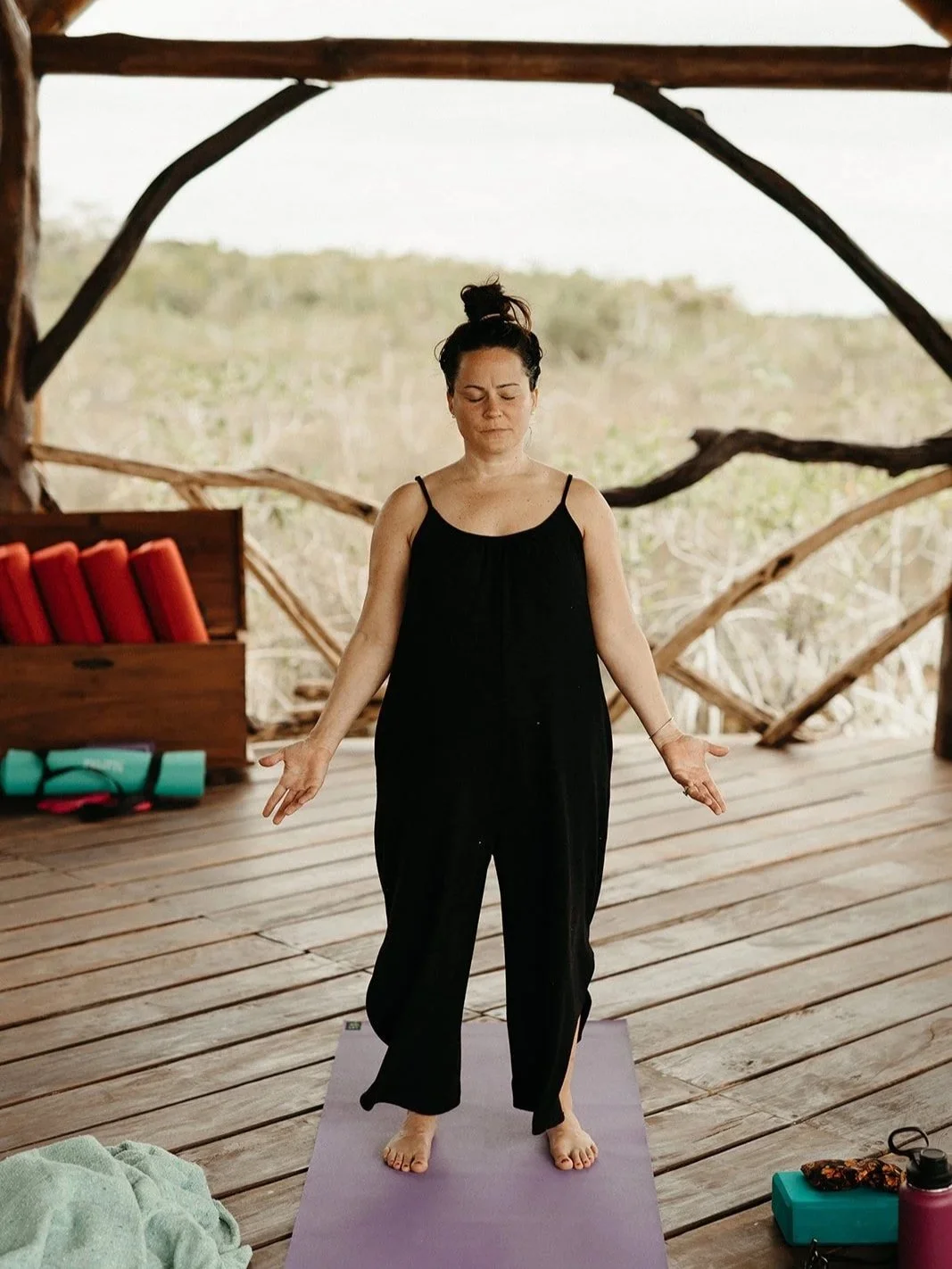
Practice: Staying with what is true
Before you begin:
Choose a posture that feels honest to your body right now. You do not need to be calm, grounded, or regulated to begin — only willing.
Arrive without correcting
Place one hand somewhere on your body that feels natural, not symbolic.
Take a breath, and let it be the breath you’re actually having. Just be yourself here, no frills.Name what is present
Gently ask yourself: “What am I afraid to say out loud?” or “What needs to be shared or spoken?”
Let the answer be simple. A feeling. A sensation. A word. Or “I don’t know.”Notice the impulse to leave. The impatience with your own process.
As you stay with this truth, notice if there is an urge to:Explain it away
Make it prettier
Judge it
Fix it
Turn it into insight
Simply notice. This is where authenticity is often interrupted.
Choose presence instead of performance
Your own presence and attention is medicine. Your own love and compassion is healing. Say quietly (out loud or internally): “I’m allowed to stay with this. It’s okay that it’s unfinished. I am worthy and deserving of my own love, just as I am right now. I don’t need to change this about myself.”Let the body lead the next moment
You may feel called to shift, stretch, soften, breathe deeper, or become still.
Let the movement — or lack of movement — be enough. Move or be still until you feel a shift or merely a sense of completeness. Take your time.Close with self-recognition
Place both hands on your body and say: “I belong to myself.”
“My feelings matter to me.” “I am here.”
This is authenticity in practice.
A closing note
Healing, to me, is almost the opposite of self-improvement. It is self acceptance: a remembrance of our own worth and inner beauty. A reclamation of the parts of ourselves we left behind in order to survive.
All that is required is willingness.
To listen.
To feel.
To stay.
Be curious. Take your time. Let yourself be quietly transformed. Reach out if you need a hand.
If this reflection resonates, you may feel called to deeper healing and energetic remembrance. You’re welcome to reach out or explore my work when it feels right.I’m here.
With love,
LuLu 🤍
Frequently asked questions about living authentically
Q: What does it mean to live authentically?
A: Living authentically means aligning your inner truth with how you move through the world emotionally, physically, and energetically.
Q: Why does authenticity feel unsafe for so many people?
A: Because many of us learned early that safety and belonging required self-erasure or performance.
Q: What is the difference between authenticity and oversharing?
A: Oversharing often comes from seeking validation or safety outside of oneself, while authenticity begins with staying connected to your body and choosing when, where, and with whom your truth is shared.
Q: How do I practice authenticity without overwhelming myself emotionally?
A: Authenticity begins with small, embodied moments of honesty — naming what is true, noticing when you want to leave, and choosing presence instead. Moving slowly, listening to the body, and allowing truth in manageable doses helps build safety and trust over time.